Quick answer. The Joker card represents the trickster, the outsider, chaos, freedom, and unpredictable change. Unlike the four suits, it does not belong to a fixed symbolic system. In card games it can be powerful, useless, wild, or removed entirely, which is why the Joker often symbolises disruption and rule-breaking.

The Joker is the card that refuses to behave. The joker card meaning is built around disorder: trickster energy, wild-card power, outsider status, and the freedom that comes from not belonging to any suit.

Spades, Hearts, Diamonds, and Clubs all have a place in the deck. The Joker does not. It enters late, changes by game, shifts meaning by context, and often holds more power precisely because it was never part of the original order.

That is why the card has stayed so magnetic in tattoo culture, gothic design, and streetwear. The Joker is not just funny. The best versions are strange, sharp, and slightly dangerous.

What Does the Joker Card Really Mean?

The Joker card means unpredictability, trickster energy, freedom, chaos, and the power to interrupt the rules. It is the outsider of the deck: a card that can matter more than anything else in one game and mean nothing in another.

That uncertainty is the point. The Joker is not fixed like Spades, Hearts, Diamonds, or Clubs. It does not carry one stable role across every game. It becomes whatever the rules allow, and sometimes the rules make it the most dangerous card on the table.

Symbolically, the Joker belongs to people who do not sit neatly inside a system. It is the mask, the laugh, the trapdoor, the figure who survives by refusing to be pinned down.

Why the Joker Does Not Belong to a Suit

The four playing card suits organise the deck into a system. Spades, Hearts, Diamonds, and Clubs each carry their own symbolic force. The Joker sits outside that structure. It has no suit, no fixed rank, and no single job that applies everywhere.

Historically, the Joker is a later addition to the standard deck, connected to nineteenth-century card games such as Euchre. That late arrival matters symbolically. The Joker is not part of the old suit order. It is the card that arrives after the system has already been built.

That outsider status gives the card its edge. The Joker can be extra, unnecessary, decisive, or dangerous. It depends entirely on the rules of the room.

The Joker, the Fool and the Trickster

In broader playing card symbolism, the Joker often gets compared with the Fool from tarot. The comparison is not exact, but it makes sense: both figures stand near the edge of order, both carry risk, and both can represent freedom through uncertainty.

The trickster is older than the deck. Folklore keeps returning to the same figure: the one who breaks rules, exposes hypocrisy, survives through wit, and turns the powerful into the foolish. The Joker belongs to that family of symbols.

That is what makes the card darker than a simple jester. The laugh can be a mask. The joke can be a weapon. The Fool can be the only person in the room who understands what is really happening.

The Wild Card Meaning: Chaos With a Purpose

The Joker is often treated as a wild card, which is why it has become a symbol of unpredictable power. A wild card can become what the hand needs. It can replace another card, change the outcome, or break a pattern that looked fixed.

That does not make the Joker random. It makes the Joker conditional. Its power depends on the game, the rules, and the moment it appears. In one context, it is worthless. In another, it wins everything.

That is the real wild-card meaning. Chaos is not always noise. Sometimes it is the only force flexible enough to beat a rigid system.

The Joker in Tattoo Culture

In tattoo symbolism, the Joker can represent rebellion, humour under pressure, chaos, survival, deception, mental sharpness, or the outsider who refuses to play clean. It is a card for people drawn to risk, masks, and contradiction.

The design language fits tattoo flash because the Joker gives artists a lot to work with: masks, teeth, crowns, torn cards, split faces, bells, daggers, skulls, and theatrical shapes. It can be comic, sinister, tragic, or all three at once.

That range is the point. The Joker does not have to choose one face.

How Crown & Bone Reimagines the Joker

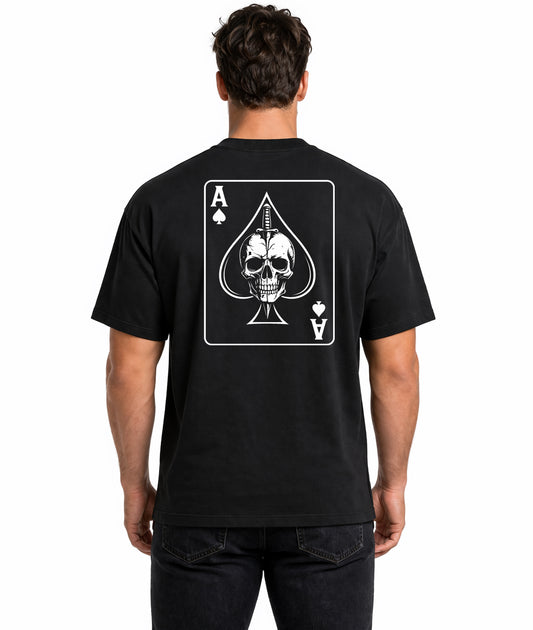
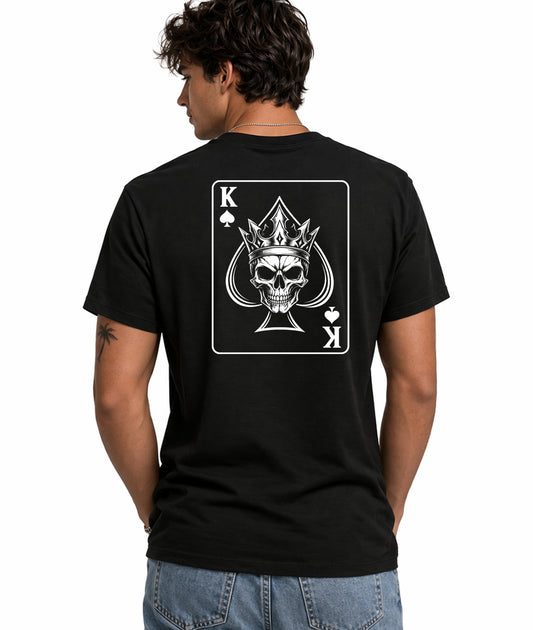
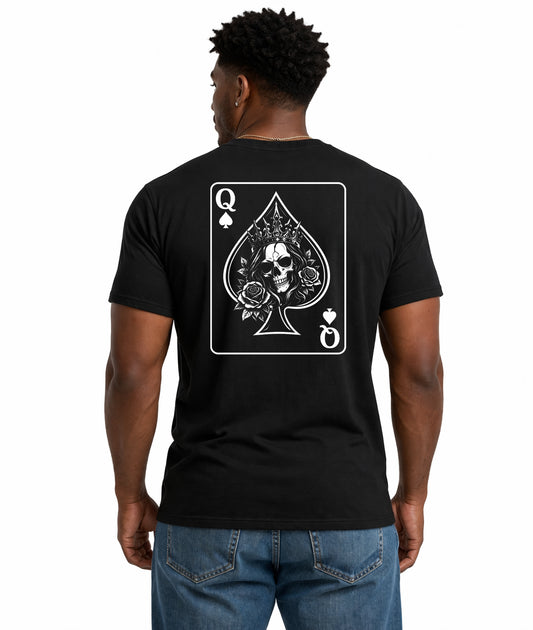
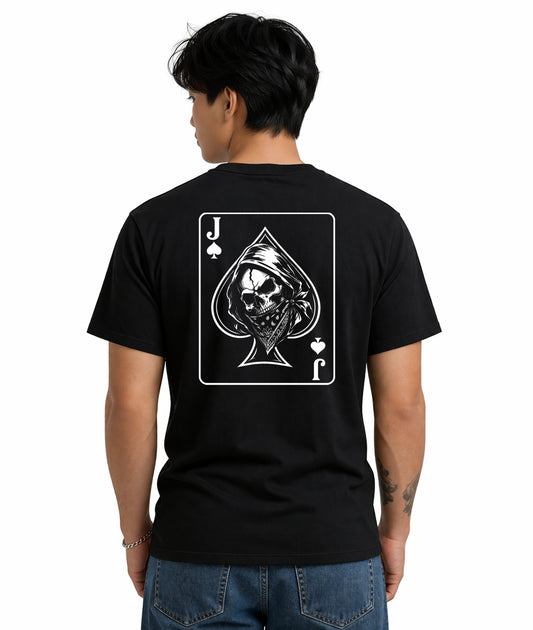
Crown & Bone treats the Joker as the card that refuses to join the court. The Kings and Queens carry rank. The Aces carry force. The Joker carries the fracture in the system.

That makes the design feel different from the suit cards. It can be looser, stranger, and more theatrical while still belonging to the same black-and-white deck. Skull iconography keeps it grounded. The playing-card frame keeps it in the collection. The split-mask energy keeps it unstable.

On black fabric, the Joker becomes exactly what it should be: the card outside the rules, rebuilt in bone, linework, and negative space.

The card outside the rules

The Joker carries chaos, wit, and outsider power. Crown & Bone turns that fracture into blackwork built for fabric.

Shop the Crown & Bone Collection

Spades, hearts, diamonds, clubs, and the card that refuses them all. Built for black. Designed to last.

See the Crown & Bone Collection
Back to blog