Quick answer. Renault's greatest hot hatches helped define affordable, chuckable performance. From the giant-killing Renault 5 GT Turbo and the mid-engined 5 Turbo, through the revered Clio Williams and the Megane R.S., to the modern R5 Turbo 3E, these are the Renault icons that made the badge legendary.

No car sums up Renault's hot hatch story like the Renault 5 GT Turbo. It took a tiny supermini, strapped on a turbo, and humbled machines costing far more. It is one of the cars Renault fans picture first, and it helped kick off a run of icons enthusiasts still chase today.

But the 5 GT Turbo is only where this article starts. From the mid-engined 5 Maxi Turbo to the revered Clio Williams, the wild Clio V6 and the track-bred Megane R.S., Renault turned low weight, balance and cheeky pace into an art form across four decades. These are the classic Renault performance cars that earned the legend.

Here are the key icons, led by the car that set the tone, and now celebrated in print by Ink & Thread.

What gives Renault hot hatches their character?

A hot hatch earns the name by turning an ordinary shopping car into something quick and playful. Renault's version adds a particular flavour: light kerb weights, soft-but-clever suspension, and a willingness to lift a rear wheel through a corner rather than plough straight on.

Renault leaned into that character hard. Where German rivals often chased composure, Renault Sport chased fun. That is why a thirty-year-old Clio can still feel more alive than plenty of modern performance cars, and why these cars hold their value and their following.

Renault 5 GT Turbo: the pocket rocket that started it

The Renault 5 GT Turbo is where the story really catches fire. Launched in 1985, it took a tiny supermini, added a turbocharged 1.4-litre engine of around 115 bhp, and wrapped it in boxy plastic arches. With very little weight to carry, it felt savage.

On boost it was a handful in the best way, and it became a giant-killer on roads and rally stages alike. Today the GT Turbo is one of the most collectable Renaults of its era, and its silhouette is instantly readable, which is exactly why it works so well on a shirt.

Wear the pocket rocket

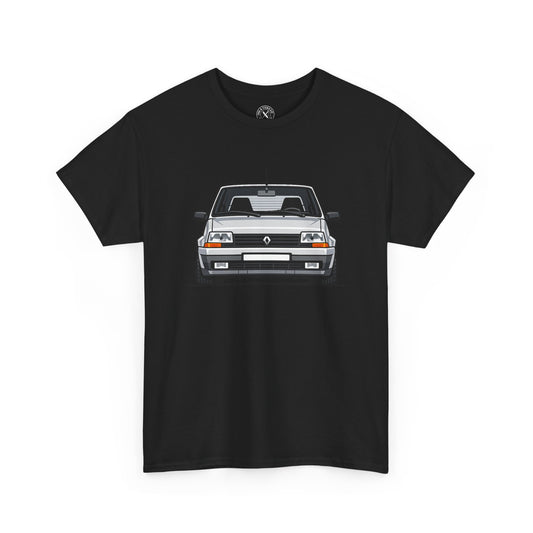
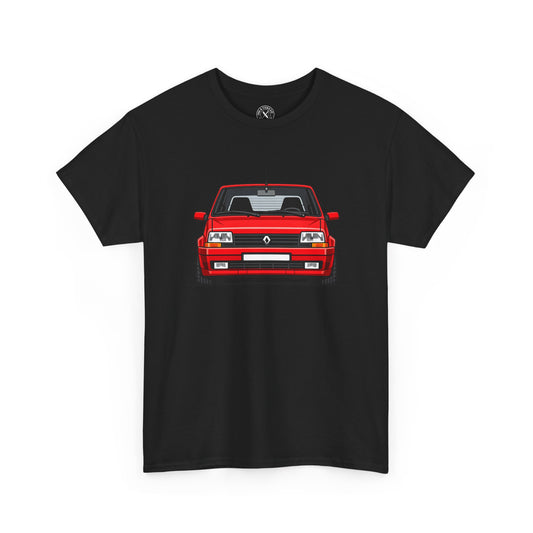
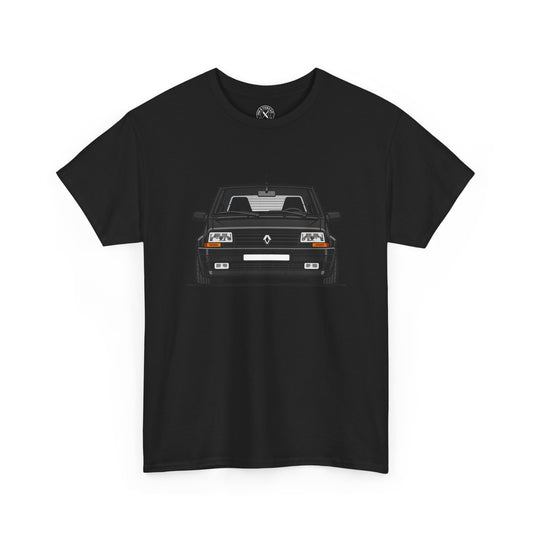
The Renault 5 GT Turbo, front and rear, in white, red and black.

Shop the Renault 5 GT Turbo tees

Renault 5 Maxi Turbo: how wild was the homologation version?

The Renault 5 Maxi Turbo answers the question of how far Renault would go. Unlike the front-engined GT Turbo, the 5 Turbo family was mid-engined, with the motor mounted behind the driver and vast arches covering its wider track. The Maxi Turbo was the Group B rally evolution, and it was genuinely wild.

These were homologation specials, built so Renault could go rallying at the top level in the 1980s. That makes the Maxi Turbo one of the rarest and most dramatic shapes in the whole Renault back catalogue: all shoulders and intent, which is why its rear three-quarter view looks so good in print.

The homologation monster

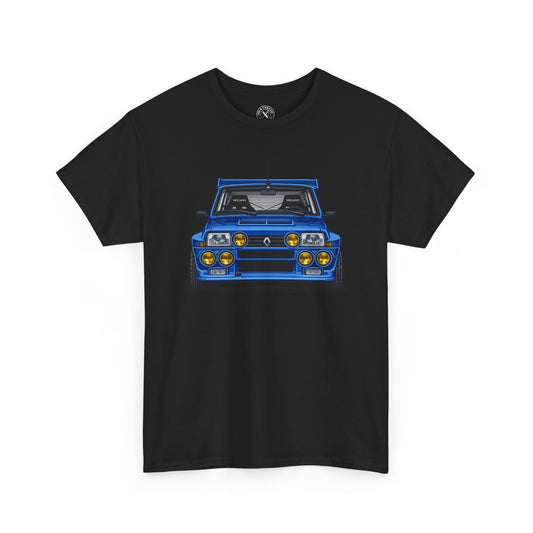
The 5 Maxi Turbo, front and rear, in black and blue.

Shop the 5 Maxi Turbo tees

Is the Clio Williams the greatest hot hatch ever?

Many enthusiasts will tell you the Renault Clio Williams is the greatest hot hatch ever made, and they have a strong case. Launched in 1993 with a 2.0-litre 16-valve engine of around 150 bhp, it paired real pace with a chassis that has become the benchmark for feel and adjustability.

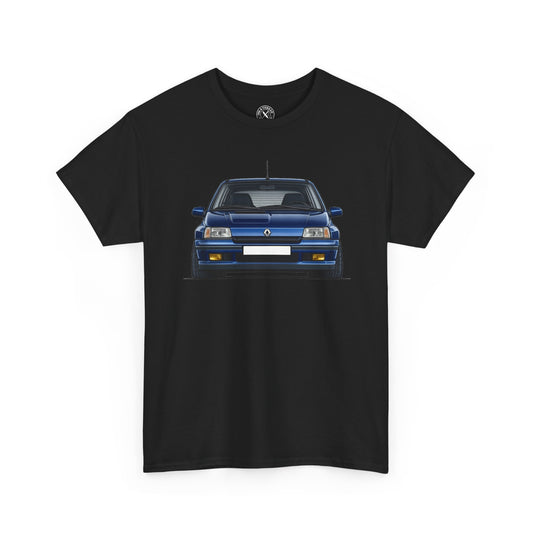
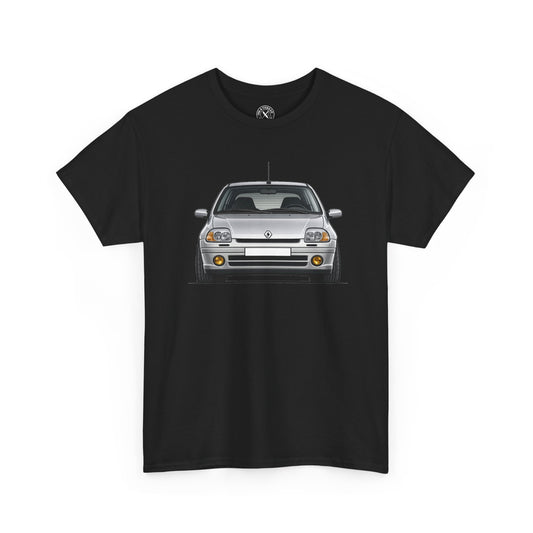
It arrived in one look that everyone remembers: Sports Blue paint over gold Speedline wheels, named for Renault's Williams Formula 1 engine partnership. It began as a limited run of 3,800 numbered cars, but demand meant Renault built more, and clean original examples are now prized. Whether or not it is truly the best, it is the one most people picture when they think of a French hot hatch.

Blue and gold, forever

The Clio Williams, captured front and rear.

Shop the Clio Williams tees

Clio Sport 172 and the V6: how far did Renault push the Clio?

Renault kept pushing the Clio well beyond the Williams. The Clio Sport 172, launched around 2000, raised output to around 170 bhp (172 PS, or metric horsepower) and became a favourite for its sharp, high-revving 2.0-litre engine and everyday usability.

Then came the outlier. The Clio V6 moved the engine to the middle of the car, fitted a 3.0-litre V6, and turned a supermini into a short, wide, rear-drive special. The Phase 1 arrived in 2001, hand-built by TWR, and the revised Phase 2 from 2003, built by Renault Sport at Dieppe, added more power and a friendlier chassis. With around 252 bhp (255 PS), the Phase 2 was the most powerful mass-produced hot hatch of its time. Nothing else in the class looked or drove like it.

Megane R.S.: what made it track-day royalty?

The Megane Renaultsport carried the torch into the modern era. The 2004 to 2008 generation, sold in versions including the R26 and the stripped-out R26.R, built a reputation for lap times that shamed pricier machinery and became a track-day staple.

Renault Sport kept the Megane R.S. going for years, right up to the 2023 Megane R.S. Ultime, the send-off for the combustion R.S. Megane. Across those generations the car repeatedly set front-wheel-drive benchmarks at circuits like the Nurburgring, and cemented Renault Sport as a genuine performance brand rather than a badge.

The new breed: is the R5 Turbo 3E the future of the hot hatch?

Renault's performance story is still being written. The Renault 5 Turbo 3E, revealed as a limited-run electric special ahead of deliveries around 2027, revives the wide-arched, mid-motor spirit of the original 5 Turbo for a battery age. With dual rear motors and a claimed 493-plus bhp (500-plus PS), it is a deliberate, visually loud nod to the icons above.

It proves the appetite for French performance has not faded. And it is not the only modern Renault flying the flag - the maddest of the lot never touched a public road at all.

Renault Sport R.S. 01: the halo racer that broke the mould

The Renault Sport R.S. 01 is the outlier that bookends this whole story. Launched in 2015, it was never a hot hatch and never road legal - it was a purpose-built GT racing car, created for its own one-make Renault Sport Trophy series.

Under the carbon bodywork sat a twin-turbo V6 of around 500 bhp, mounted in a race-bred chassis, giving supercar pace and a 0-60 mph time near 3.5 seconds. Where the 5 GT Turbo showed how little you needed to have fun, the R.S. 01 showed how far Renault Sport would go when the road rules no longer applied. Together they mark the two ends of the same obsession.

Which classic Renault performance icon is right for you?

Each of these Renaults offers a different flavour of the same idea. Figures are approximate and vary by version and source.

Model Era Engine / power 0-60 mph Claim to fame
Renault 5 GT Turbo 1985-1991 1.4 turbo, around 115-120 bhp Around 7.5 sec Featherweight giant-killer
Renault 5 Maxi Turbo 1980s Mid-engined Group B rally bloodline; road Turbo 2 around 160 bhp Around 6.6 sec for road Turbo 2 Homologation legend
Renault Clio Williams 1993 2.0 16v, around 148 bhp Around 7.7 sec The benchmark for feel
Clio Sport 172 Around 2000 2.0 16v, around 170 bhp / 172 PS Around 7.0 sec Sharp everyday hot hatch
Clio V6 2001-2005 3.0 V6, mid-engined rear-drive, around 223-255 bhp Around 5.6-6.2 sec The supermini supercar
Megane R.S. 2004-2008 2.0 turbo, around 225-230 bhp Around 5.9-6.3 sec Track-day royalty
Megane R.S. Ultime 2023 1.8 turbo, around 300 hp Around 5.7 sec to 100 km/h The combustion send-off
Renault 5 Turbo 3E Expected around 2027 Electric dual-motor setup, claimed 493-plus bhp / 500-plus PS Around 3.5 sec to 100 km/h, claimed The icon reborn
Renault Sport R.S. 01 2015 Twin-turbo V6, around 500 bhp, track-only Around 3.5 sec The halo racer

If you want the definitive starting point, the Renault 5 GT Turbo and the Clio Williams are the two most recognisable shapes in the range, and the two most people fall for first.

Shop the Renault tees available now

The designs you can buy today, shown front on. More models from the list above are on the way.

Frequently asked questions

What is the best Renault hot hatch?

The Renault Clio Williams is often named among the best Renault hot hatches, thanks to its 2.0-litre 16-valve engine of around 150 bhp and a chassis widely regarded as a benchmark for feel. The Renault 5 GT Turbo runs it close as the featherweight giant-killer that helped build Renault's hot hatch legend. The honest answer depends on taste: the Williams for balance, the 5 GT Turbo for raw character.

What engine does the Renault 5 GT Turbo have?

The Renault 5 GT Turbo uses a turbocharged 1.4-litre four-cylinder engine producing around 115 bhp, depending on the version. Because the car weighs so little, that modest figure delivered vivid performance for its era, and made the 5 GT Turbo a genuine giant-killer on both road and rally stage through the late 1980s.

Is the Renault Clio Williams a good investment?

The Renault Clio Williams has become a sought-after modern classic, and clean, original examples are prized among enthusiasts. It began in 1993 as a numbered limited run, and its status as one of the most revered hot hatches ever built supports strong interest. As with any classic car, condition, originality and history matter most, so values vary. This is general information, not financial advice.

What was the Renault 5 Maxi Turbo?

The Renault 5 Maxi Turbo was the Group B rally evolution of the mid-engined Renault 5 Turbo. Unlike the front-engined 5 GT Turbo, it carried its engine behind the driver and wore hugely widened arches. Built as a homologation special so Renault could compete at the top level of 1980s rallying, it is one of the rarest and most dramatic shapes Renault has ever produced.

Are the Ink & Thread Renault tees available in different colours?

Yes. The Ink & Thread Renault range covers several cars and views, and the tees come in options including white, black and other colourways, with a range of sizes. You can see the current line-up, including the Renault 5 GT Turbo, the 5 Maxi Turbo and the Clio Williams, on the Renault collection page.

Wear the legend

The cars that defined French performance, drawn with the detail they deserve and printed to be worn.

Shop the Renault collection

Front and rear views, multiple colours, sizes S to XXL.

Shop Renault tees
Back to blog